










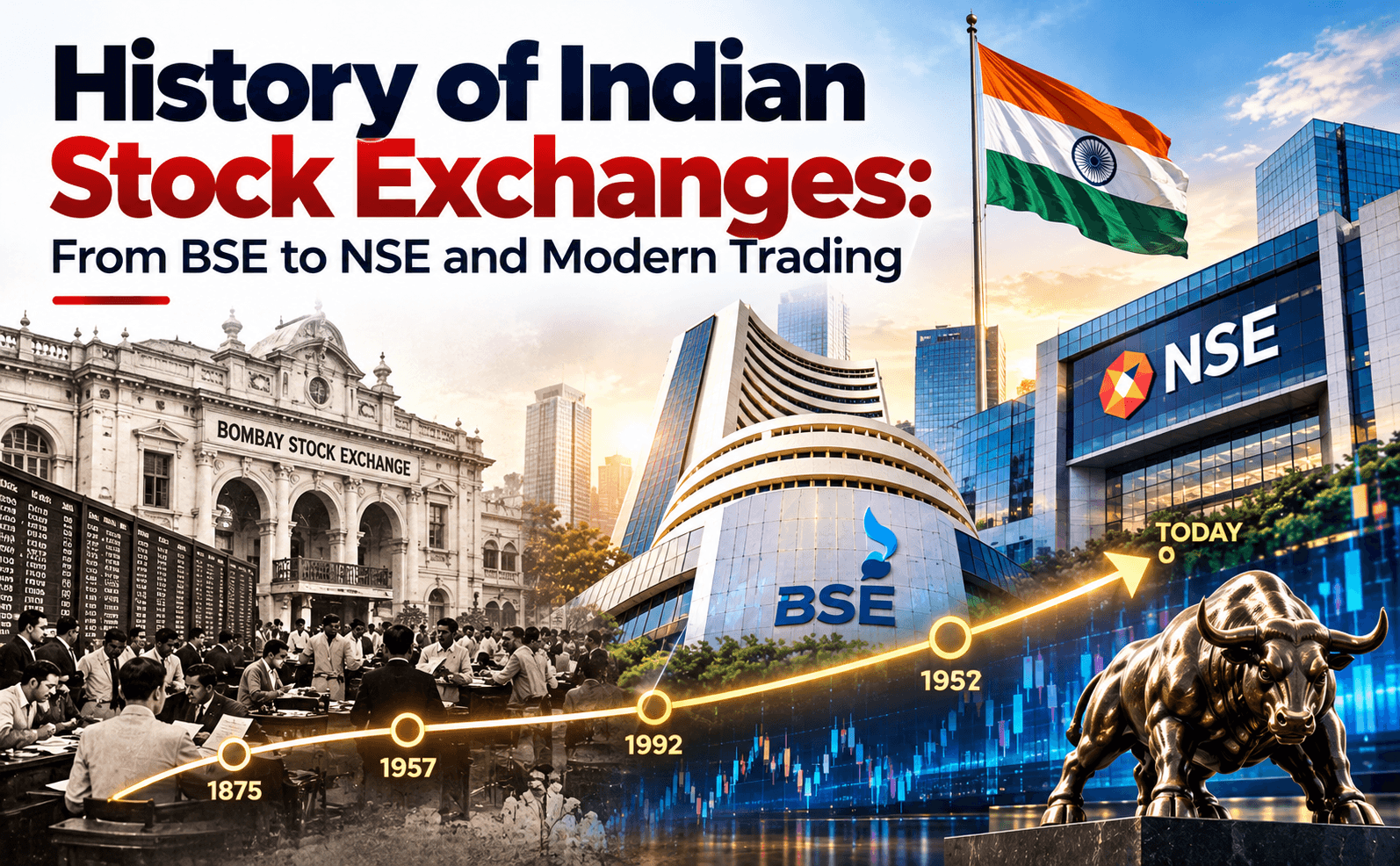
Chronicle of Indian Stock Exchanges: The Journey from BSE to NSE and Contemporary Trading Practices
A Glimpse into the History of Indian Stock Exchanges
The evolution of stock exchanges in India mirrors the shift of the nation’s financial landscape from unsophisticated securities trading to a contemporary, technology-oriented marketplace. Throughout the years, stock exchanges have been pivotal in enabling businesses to secure funding, granting investors the ability to trade various securities, and facilitating the maturation of India’s capital markets.
A significant landmark in this journey is the founding of the Bombay Stock Exchange (BSE) in 1875. Additionally, the National Stock Exchange (NSE), incorporated in 1992 and commencing its trading operations in 1994, revolutionized the trading process by implementing a nationwide electronic trading system, fundamentally altering the methods by which securities are bought and sold in India.
Substantial regulatory reforms, the advent of electronic trading systems, dematerialized securities, and enhanced market infrastructure have collectively contributed to making the Indian stock market more accessible and transparent. Grasping this historical progression is crucial for understanding concepts such as IPOs, listed entities, market indices, and the nuances of stock exchange operations.
The Inception of the Indian Stock Market
The foundations of organized securities trading in India can be traced back to the 19th century in Bombay, now known as Mumbai. During this era, a surge in economic activities, commercial enterprises, and the expansion of businesses sparked interest in trading shares and other financial instruments.
Prior to the establishment of formal exchanges, transactions were facilitated by brokers within informal groups and associations. As trading activities flourished, the demand for an orderly marketplace with standardized practices became increasingly evident.
In 1875, a collective of brokers founded the Native Share and Stock Brokers' Association in Bombay, which ultimately laid the groundwork for the present-day Bombay Stock Exchange. This milestone marked a pivotal advancement towards organized securities trading within India.
Bombay Stock Exchange (BSE): The Dawn of Structured Trading
The Bombay Stock Exchange (BSE), established in 1875, stands as Asia's oldest stock exchange. Its growth is intricately linked to the advancement of India’s commercial and industrial economy.
Over time, the BSE fostered a more organized environment for trading shares and securities. It evolved into a vital platform for companies seeking investor engagement and for market participants aiming to buy and sell listed securities.
Key Developments in BSE's History
- 1875: The establishment of the Native Share and Stock Brokers' Association in Bombay.
- Late 19th century: The emergence of organized trading coincided with the growth of commercial and industrial sectors.
- 20th century: The BSE enhanced its trading infrastructure and became a central pillar in India’s securities market.
- Modern era: The introduction of electronic systems revolutionized trading, substituting traditional floor operations with prompt, computer-driven transactions.
The BSE has significantly contributed to the expansion of India's capital markets by offering a platform for listed corporations and investors alike. It also manages benchmark indices that provide insights into the price movements of select stocks.
National Stock Exchange (NSE): A New Chapter in Electronic Trading
The National Stock Exchange (NSE) was founded in 1992, officially recognized by the Securities and Exchange Board of India (SEBI) in 1993, and commenced trading in 1994.
NSE introduced fully automated, screen-based trading in India. This innovation reduced the reliance on physical trading floors and direct broker interactions, enabling investors and trading members to place orders via electronic systems connected to the exchange.
This technology-centric model broadened access to stock market trading nationwide and enhanced the efficiency of matching buy and sell orders, resulting in improved price transparency.
Noteworthy Milestones of NSE
- 1992: Incorporation of NSE.
- 1993: Recognition as a stock exchange by SEBI.
- 1994: Launch of operations in the wholesale debt market, followed by the introduction of equity trading on electronic platforms.
- 1996: Introduction of the Nifty 50 index, serving as a gauge for the performance of prominent companies listed on the NSE.
- 2000: Unveiling of index options tied to the Nifty index and expansion of derivatives offerings.
- Subsequent years: The incorporation of online trading, mobile accessibility, new financial instruments, and technological updates further enriched the exchange’s services.
The establishment of the NSE has had a transformative impact on the landscape of Indian securities trading, creating a more accessible and technology-driven market environment.
Formation and Function of SEBI
The Securities and Exchange Board of India (SEBI) serves as the primary regulator of India's securities markets. Originally established in 1988, it became a statutory body under the SEBI Act in 1992.
With the expansion of India’s capital markets, regulatory oversight became crucial for safeguarding investor interests, ensuring orderly trading practices, and fostering transparency in market operations. SEBI's purview includes monitoring market participants and exchanges, ensuring compliance with regulations, and protecting the rights of investors.
Regulatory advancements have established a framework for public offerings, disclosure norms, market conduct, and the functioning of intermediaries, which holds particular relevance for investors involved in IPOs and trading listed securities.
For official details regarding the regulator’s roles and responsibilities, visit the SEBI website.
Shift from Traditional Trading to Electronic Markets
The transition from traditional floor-based trading to electronic trading is one of the most notable changes in the annals of Indian stock exchanges.
In earlier trading frameworks, brokers convened on exchange floors to negotiate and execute trades. While this method facilitated organized trading, it had limitations regarding geographical scope, transaction speed, and the accessibility of market information.
With the advent of electronic trading came the implementation of computer-mediated order placement and matching. This innovation allowed investors to interact with the market via registered trading members without requiring physical presence on the trading floor.
Key enhancements associated with electronic trading included:
- Accelerated order execution: Electronic systems enabled automated order matching.
- Wider market access: Trading became available to participants across diverse locations.
- Enhanced price visibility: Electronic platforms provided real-time access to market prices and order details.
- Improved oversight: Computerized records and monitoring systems facilitated better scrutiny of trading activities.
- Rise of online investing: Internet-based platforms and mobile apps simplified market access for investors through licensed brokers.
This transition laid the groundwork for the technology-driven stock market that today’s investors navigate.
Dematerialization: Transitioning to Electronic Securities
Another pivotal development was the advent of dematerialized securities, commonly referred to as demat holdings. Prior to dematerialization, investors typically held shares in physical form, which posed risks related to documentation, delays in transfer, and the potential for loss, damage, or counterfeit certificates.
Dematerialization allowed securities to exist electronically through depository systems. The establishment of the National Securities Depository Limited (NSDL) in 1996 was a significant achievement within this transformation.
This shift to electronic holdings simplified the process of securities transfer and enhanced settlement efficiency. Presently, investors predominantly utilize demat accounts to hold eligible securities electronically, with trading accounts employed for placing orders via registered brokers.
The Advancement of Key Indian Stock Market Indices
Stock market indices play a vital role in helping investors gauge the performance of a select group of securities. They offer benchmarks for market movement analysis and investment performance comparison.
BSE Sensex
The BSE Sensex serves as a benchmark index associated with the BSE. It monitors a curated group of prominent companies listed on the exchange and is widely regarded as an influential indicator of shifts within India’s equity market.
Nifty 50
The Nifty 50 represents the flagship benchmark index linked to the NSE. Established in 1996, it tracks a selection of large, actively traded corporations spanning various sectors within the Indian economy.
Both indices are commonly referenced by investors, analysts, and financial media as a means to discuss market trends. However, the performance of an index does not universally reflect the returns of every listed stock or every investor's portfolios.
The Surge of IPOs and the Indian Primary Market
As the infrastructure of stock exchanges matured, the Indian primary market emerged as a significant avenue for companies seeking to gather funds from public investors.
An Initial Public Offering (IPO) permits a company to offer shares to the public and, pending compliance with regulatory requirements, pursue listing on an exchange. IPOs can assist companies in acquiring capital for expansion, debt repayment, business initiatives, or providing an exit route for existing shareholders via an Offer for Sale.
Modern IPO processes entail electronic applications, disclosure requirements, subscription tracking, allotment procedures, and listing on exchanges. Investors have access to various information sources before deciding to participate in a public offering.
- IPO subscription data allows investors to evaluate demand across different investor categories.
- IPO allotment status enables applicants to verify the results of an issue post-allotment.
- IPO market analytics offers insights into IPO trends and associated market activities.
- IPO listing performance provides a platform for examining historical listing outcomes.
These indicators serve various functions and should be considered in conjunction with the company's offering documents, financial status, valuations, and inherent risks. Previous listing gains or losses do not assure the outcomes of forthcoming IPOs.
The Current Operation of Indian Stock Exchanges
Today, India's stock market functions through a complex network of exchanges, brokers, clearing corporations, depositories, and other regulated entities. BSE and NSE serve as the nation's leading equity exchanges, both facilitating trading for eligible securities in accordance with prevailing regulations.
The contemporary trading process typically unfolds through the following stages:
- Account setup: An investor registers trading and demat accounts with authorized service providers.
- Order placement: The investor submits a buy or sell order via the broker's trading platform.
- Order matching: The trading system of the exchange aligns compatible buy and sell orders based on established regulations.
- Clearing and settlement: The relevant clearing and settlement infrastructure processes the transaction alongside the transfer of funds and securities.
- Electronic holdings: Upon settlement, purchased securities are credited to the respective demat account.
Exchanges additionally engage in market supervision, risk management, and the dissemination of trading data. These responsibilities are vital for upholding orderly market dynamics and bolstering investor confidence.
Ongoing Challenges and Developments
Despite significant advancements in market infrastructure, Indian stock exchanges navigate a landscape continually influenced by technological evolution, investor involvement, regulatory changes, and global economic factors.
Crucial areas for ongoing enhancement include:
- Technological resilience: Ensuring the robustness of trading systems and safeguarding market infrastructure against disruptions.
- Investor education: Equipping market participants with knowledge about financial products, market risks, and the necessity of informed decision-making.
- Market surveillance: Scrutinizing unusual trading behavior and enforcing applicable regulations to counteract market malpractice.
- Digital accessibility: Augmenting access to financial data and trading services through online and mobile mediums.
- Innovative financial products: Promoting the creation of investment and risk-management instruments within the regulatory framework.
As participation and technology continue to evolve, it is imperative for exchanges and regulators to maintain a balance between innovation, market efficiency, and the protection of investors.
Frequently Asked Questions
Which stock exchange is the oldest in India?
The BSE, originally founded as the Native Share and Stock Brokers' Association in 1875, holds the distinction of being the oldest stock exchange in India and Asia.
When did the National Stock Exchange commence operations?
The NSE was incorporated in 1992, recognized as a stock exchange in 1993, and initiated its operations in 1994.
What impact did the NSE have on the development of India's stock market?
The NSE transformed the landscape of Indian securities trading by implementing automated, screen-based trading and broadening access to electronic markets throughout India.
When was the Securities and Exchange Board of India established?
Initially constituted in 1988, SEBI was designated a statutory body under the SEBI Act in 1992.
What distinguishes BSE Sensex from Nifty 50?
The BSE Sensex serves as a benchmark index tied to the BSE, while the Nifty 50 is a benchmark index linked to the NSE. Both indices monitor selected companies and are commonly used to understand overall market trends in India.
Why was the process of dematerialization significant for Indian stock exchanges?
Dematerialization revolutionized the holding and transfer of securities by facilitating electronic management, minimizing dependence on physical certificates, and streamlining transactions within the securities market.
Do stock exchanges guarantee profits for investors?
No. While stock exchanges provide regulated trading environments, they do not assure profit margins for investors. Share prices may fluctuate, leading to potential losses for investors.
Conclusion
The narrative of Indian stock exchanges encapsulates the remarkable evolution of the country's financial markets, transitioning from informal broker networks to structured exchanges backed by electronic trading and advanced market infrastructure.
The establishment of the BSE in 1875 marked a formative step towards organized securities trading, while the NSE's introduction of electronic trading in the 1990s, the regulatory framework shaped by SEBI, and the move towards dematerialized securities further transformed the market landscape.
Today, stock exchanges serve a critical function in capital formation, price discovery, and the trading of securities. Understanding their historical context enables investors to appreciate the systems governing IPOs, listed securities, benchmark indices, and the broader spectrum of the Indian financial market.
Disclaimer: This article is intended for educational purposes only and does not represent financial advice or a recommendation for buying or selling any securities.